
Plate · Format II
A Phrenology of the Home Desk
Plate III. — The working surface mapped into its nine faculties, after the manner of the cranial atlases.
By the Editor · 6 min · The Plate
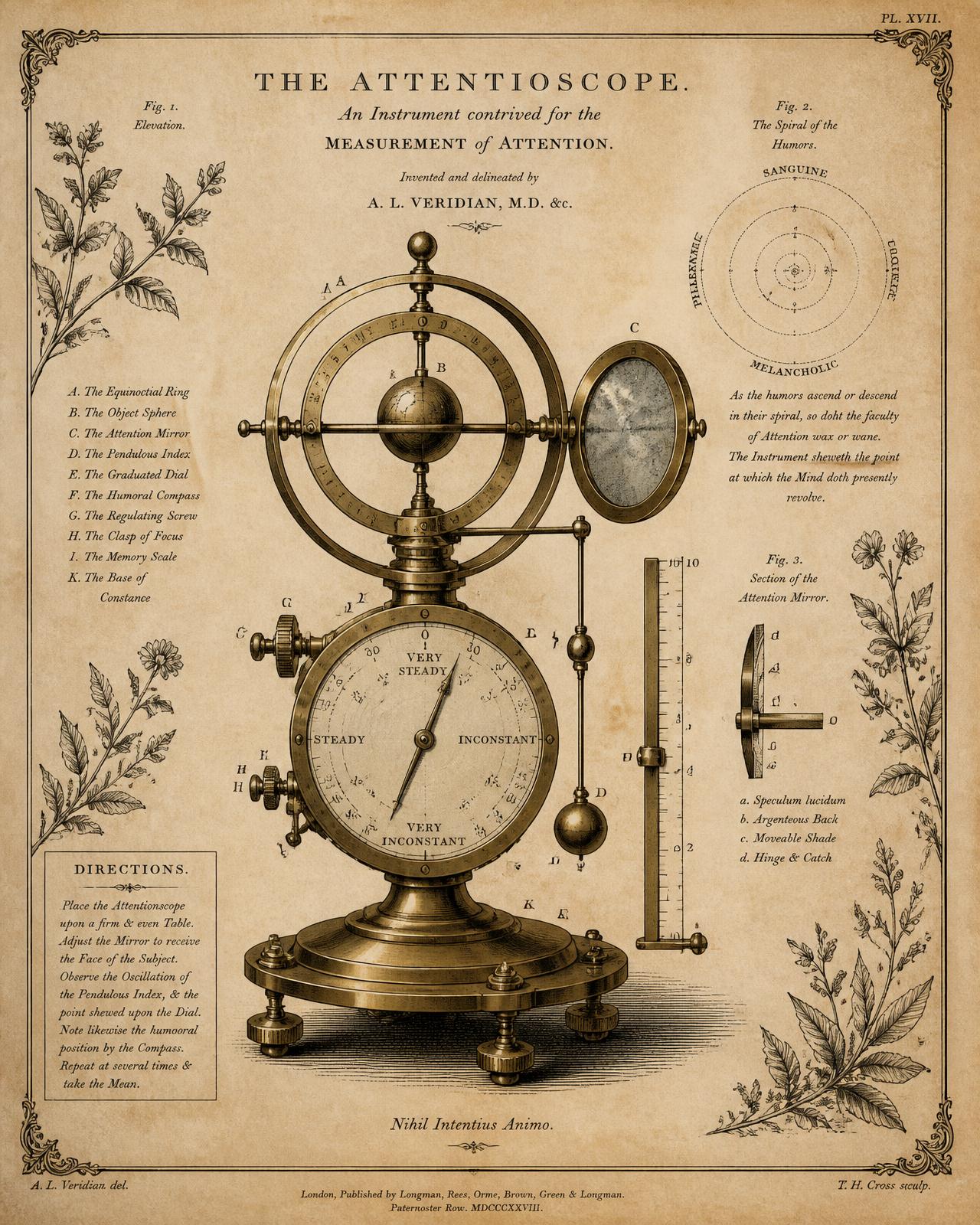
Key to the Plate
- 1. Amativeness — the photograph turned at an angle only its owner reads
- 2. Vigilance — the notifications quadrant; kept nearest the writing hand
- 3. Acquisitiveness — cables, held against a future in which they are needed
- 4. Veneration — the visible spines, arranged for a camera
- 5. Alimentiveness — the ring, and the second ring inside the first
- 6. Order — a rectangle of clear wood, defended daily, used for nothing
- 7. Secretiveness — the drawer; unopened since the move
- 8. Hope — the notebook bought for a project not yet begun
- 9. Concentrativeness — the chair's worn arm, where the elbow returns
The Reading
The phrenologists were wrong about the skull and right about the appetite. Gall's error was not the belief that character has regions — it is that he looked for them under the bone, where nothing had been placed on purpose. A desk has the advantage of being arranged by its owner, daily, without supervision, and never once with the intention of being read.
Note that the faculties do not divide evenly. Vigilance (2) has annexed the whole upper right, as it does in nearly every specimen we have examined; Order (6) occupies the geometric center and is empty, which the older atlases would have called an unexercised organ. Secretiveness (7) is not on the surface at all. It is the drawer, and we have not opened it, on the grounds that a taxonomy which disturbs its subject is a taxonomy of the disturbance.
The editor asks the reader to perform the measurement at home, in the following manner: leave the room for one hour, return, and record only what your hand reaches for before your eye arrives. Those regions are real. The rest is furniture.