
Applied Archaism
I Kept My Grocery List in a Memory Palace
The classical art of memory, followed to the letter, for one week of ordinary shopping.
By the Editor · 11 min · Applied Archaism
The System
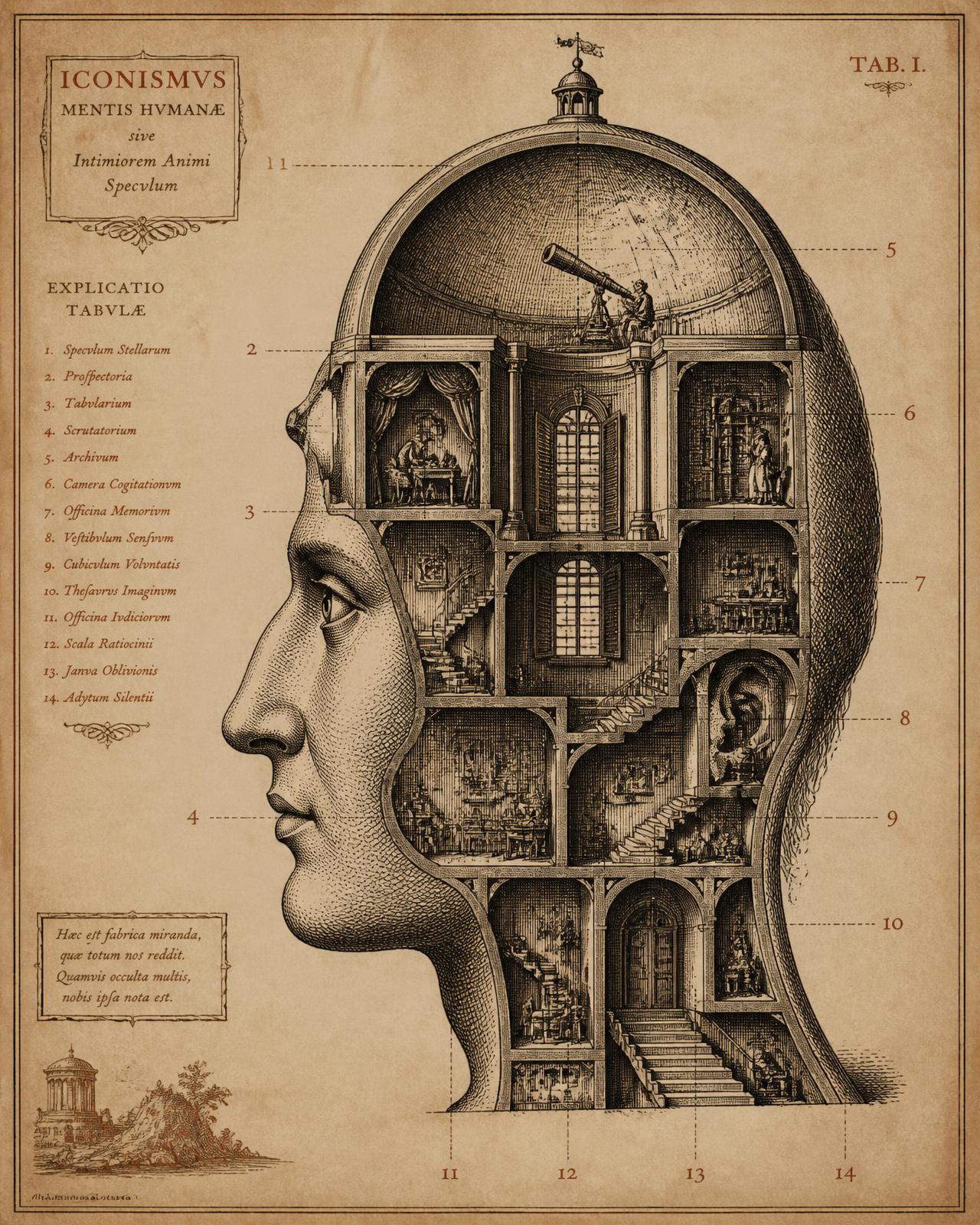
The art of memory begins, according to Cicero, with a collapsed roof. The poet Simonides stepped outside a banquet hall moments before it fell and was afterward able to name every crushed guest, because he could recall where each had been sitting. From this the ancients drew a method: to remember a list, walk a building you know well and leave one vivid image in each room. To recall the list, walk the building again.
The rules, as the anonymous author of the Rhetorica ad Herennium set them down around 80 BCE, are unexpectedly strict. The places must be in a fixed order and moderately lit. They must not be crowded together. The images left in them must be striking — disfigured, bleeding, comic, smeared with red paint — because the mind declines to retain anything ordinary. This last instruction is the one everybody forgets, and it is the one that does all the work.
The Application
I chose my mother's house, because I can walk it with my eyes closed and because it is the only architecture I am certain of. Front step, hallway, coat hooks, kitchen, the landing with the loose board, the bathroom, the back bedroom. Seven places. A week's shopping rarely exceeds seven categories, which I take as evidence that the ancients understood retail.
Monday's list was: milk, lemons, chicken thighs, coffee, dish soap, bread, and batteries. The Ad Herennium is clear that a mnemonic image must be doing something. So: a cow stood on the front step, patient, filling the milk bottles herself, one hoof on the boot scraper. In the hallway a lemon tree had come up through the carpet and was pushing the radiator sideways. On the coat hooks, in place of coats, hung the chickens.
This is where the method stops being charming. The chickens were unpleasant. I had followed the instruction to make the image striking, and the instruction had been followed correctly, and I did not enjoy the result. In the kitchen my grandfather — dead nineteen years — was grinding coffee with great seriousness, and I stood in the aisle at the shop for a moment longer than a person normally stands.
By Wednesday the palace had a maintenance problem. Tuesday's cow was still on the step, faintly, under Wednesday's crate of oranges. The classical sources anticipate this and recommend keeping several buildings in rotation, or deliberately wiping the places clean, as one wipes a wax tablet. I tried the wiping. It does not work the way erasing works. What you get is not an empty room but a room with a faint cow in it.
Accuracy: I did not forget a single item all week. Not one. Six months of the notes app on my phone had never produced a week like that. But I want to be precise about the cost, because it is the interesting part. Building the palace each morning took between four and six minutes. Writing a list takes forty seconds. The method is roughly eight times slower than the technology it replaces, and better at exactly one thing: it makes the list impossible to lose, because the list is no longer a separate object.
We ought, then, to set up images of a kind that can adhere longest in the memory. And we shall do so if we establish likenesses as striking as possible. — Rhetorica ad Herennium, III.xxii
On Friday I bought nothing. I built the palace anyway, out of a habit four days old, and found I had furnished the landing with a thing I did not need: the loose board, lifted, with a note under it. The note was not on the list. The note was the fact that I had not called my mother. The system had, without being asked, used the space I gave it.
The Residue
Here is what survived. A grocery list is a document that assumes you will be a slightly different person by the time you read it — an errand handed forward to a stranger with your name. The memory palace refuses that arrangement. It insists the errand stay inside you, in a house you grew up in, attended by people who are not available for comment. It makes shopping expensive in the only currency the ancients cared about: attention.
I have gone back to the notes app. I did not expect to miss anything and I do. Somewhere near the coat hooks, most weeks, there is still a chicken.